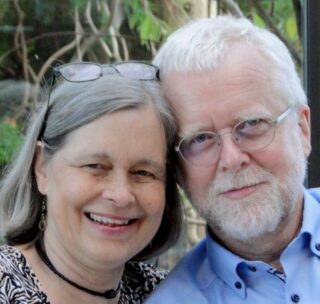
Martin and Claudia Bussey
Teaching theology in Africa for almost 40 years has been … well, many words could be used, but ‘fascinating’ is one of them!
Currently my wife and I live on a beautiful university campus just outside Nairobi, Kenya. (It’s actually ‘at the foot of the Ngong Hills’, for those of you who have seen the film ‘Out of Africa’.) Our five sons have all left home and scattered across the world: one in The Netherlands (with his family), three in the USA (with their families) and one in Germany (working at a Christian boarding school: Black Forest Academy). For the last 15 years I have been teaching at NEGST (Nairobi Evangelical Graduate School of Theology) one of the schools which make up AIU (Africa International University)—a Christian university, which continues to teach theology at all levels (Diploma to Ph D), but also offers degrees in various non-theological subjects (e.g. Psychology, Education, Counselling, IT, Business Studies, etc.).
So here am I, from my British culture, trying to explain to students who come not only from Kenya, but also from many other African countries (including Ethiopia, S. Sudan, Uganda, DRC, Nigeria) the great themes and doctrines of the Bible—a book made up of 66 books written in various cultures over a period of about 1,500 years. It’s quite a challenge; but truly a delight and a privilege.
The times in the classroom are always interesting. The students are mainly pastors, but also chaplains, youth workers, Sunday School teachers and “ordinary” Christians who just want to learn more than they can in their churches. They vary in age, although the average is late 30s or early 40s, and academic ability. Some from South Sudan, for example, struggle with English. The three hour long classes are quite traditional—I talk, they ask many questions, I ask many questions, and there are often lively discussions—sometimes very lively discussions.
Pray that something of what we are doing is helping to extend the kingdom of God in this fascinating country of Kenya
I have got into the ‘rut’ of teaching some wonderful courses: the Theology of God, the Theology of Humanity and Sin, the Theology of the Church and End Times, and The Gospels. The subject matter is glorious: in the Gospels we look at how each gospel writer presents Jesus in a unique way, with emphases particularly relevant to his first readers; but of course we also look at the great themes—repentance and faith, the kingdom of God/heaven, the passion (suffering) of Jesus, for example—which all of the gospels share; and in so doing get to look at the very best and richest passages in the gospels. (I know, all the passages are rich, but surely some are more obviously rich than others: the baptism of Jesus, the temptations, the transfiguration, the cursing (not cleansing!) of the temple, the parable of the two lost sons (which should not be called the parable of the prodigal son), etc. etc. etc. etc. Wonderful, wonderful passages. In the Theology of God we look at the Sovereignty of God, and the holiness, the wrath, the grace of God, as well as the great truths that he is everywhere present, all knowing, and all powerful—and how these doctrines are to affect us and how we live and think and minister to others.
Some students take all of these courses with me—so that means I get up to 150 hours in the classroom with them, and then I am able to set them a few hundred hours’ worth of assignments, where I “make” them read and study truly edifying material by the best authors (eg chapters from ‘Knowing God’, by Jim Packer). Then of course I have to mark all the assignments—which are way too many when there are perhaps 25 taking the class in person, and another 20 taking the class on line.
But the lecture times and the assignments combine to give a huge opportunity to make a difference in the thinking and understanding of the students: to hammer home into their heads, and hopefully into their hearts and wills, the great truths of God and his purposes of grace with men and women.
One lecture I gave last semester was on “regeneration” which gave the opportunity for a detailed look at John chapter 3 and its teaching on the new birth. How radical a teaching that is for these students (and through them, for their congregations), when so often in their churches little is heard of God’s sovereign work of grace and the radical change that brings! And there is so much that is fundamental to the gospel, but which is largely unknown and untaught in the churches here. And all the time, no matter what the subject, the aim is to search the Scriptures together, to look at what the Bible says in context (ah, what a key phrase—and for some students, what a novel idea) and to urge them to believe the truth, to live it and to teach it to others.
“…This teaching has enabled me to make sense of so much of what I’ve been seeing over the last 20 years in my work as a pastor.”
One particularly encouraging student over the last few years has been Martin. He is a man in his late 40s, has been a pastor for over 20 years and is currently head of a Pentecostal denomination. A while back he was in the “Theology of Humanity and Sin” course I was teaching. We looked at, among other things, man in the image of God, the relationship between men and women, the nature and extent of sin, the effects of sin, total depravity, indwelling sin and mortification! He wrote and told me how it had affected him: “This course has completely transformed me and my ministry. I’ve never before realised that sin affects all aspects of our personality – our minds, our hearts, our consciences and our wills; and that even good things, if done with wrong motives, are not pleasing to God. I now understand what indwelling sin is and how Christians must and can, by the grace of God, be ‘putting sin to death’. This teaching has enabled me to make sense of so much of what I’ve been seeing over the last 20 years in my work as a pastor.”
How wonderful that he had come to see these things – but how sad that he had been a pastor for so long before he understood them! Once a month one of his responsibilities is to hold a seminar to train the other preachers in the denomination. It seems he takes the notes from my classes and teaches the preachers what he himself has been learning, hopefully making it clearer and more relevant to the Kenyan situation than I can!
Another student – a mother of four young girls – sent a text: “Just to acknowledge the reading for assignment 1. I am speechless… The book, “Jesus, Suffering Servant, Sovereign Lord” has totally changed me and brought healing and understanding. God bless you, Sir, and your family. Amen.”
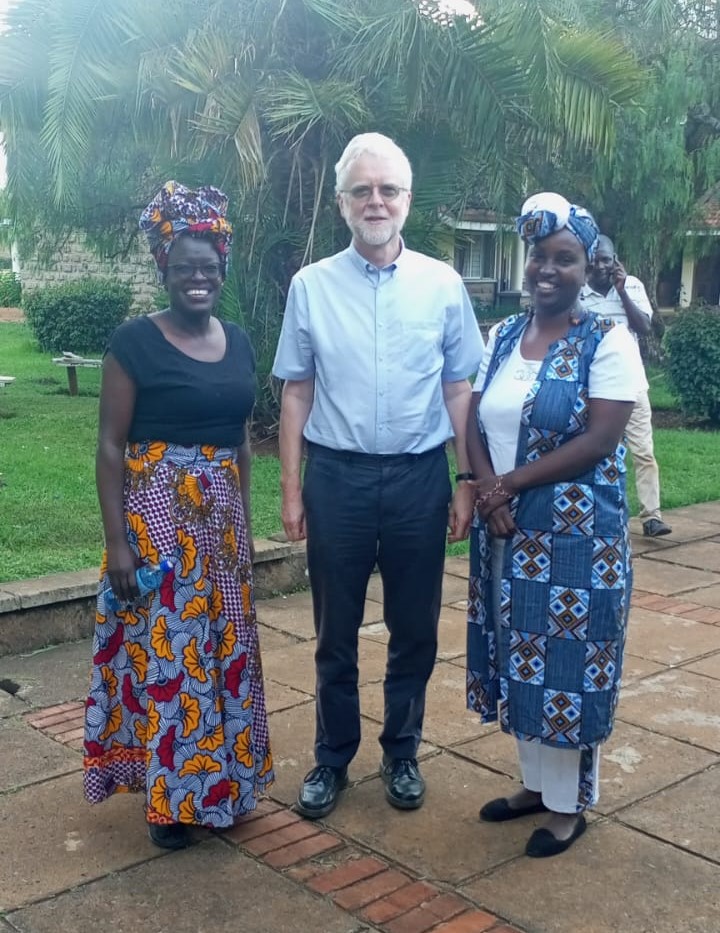 So here we are, by the grace of God, in Nairobi; with its ludicrous driving, armed robbers, terrorist threats and immense social problems. But, also by the grace of God, we are very happy to be here and pray that something of what we are doing is helping to extend the kingdom of God in this fascinating country of Kenya.